Travel Tips

Top 10 things to do in Beijing

Share
  • 1. Visit the ruins of the Yuan Ming Yuan or Old Summer Palace

  • 2. See the Beijing National Stadium or the Bird's Nest

  • 3. Visit China Nationalities Museum

John Tiong

FROM old ruins to royal palaces to the world´s largest steel structure, China´s second largest is a fascinating place to visit, writes JOHN TIONG.

BEIJING, which has a population of 17 million, is China´s second largest city after Shanghai.

The first thing any taxi driver will tell tourists is that Beijing or the Northern Capital is a very old city.

It started out at the present Guanganmen, Xuanwu District in 1040 BC. It was called Zhongdu (Central City) during the Jin Dynasty (1115-1234) and Dadu (Great City) by the Mongols in the 13th Century.

It was renamed Beiping or Northern Peace during the Ming Dynasty. And like its name that keeps on changing, the city keeps morphing into something new. You cannot savour all of Beijing in a week.

Even with two trips, I could not fulfil my goal to thoroughly see the Forbidden City now renamed Palace Museum.

You may need more than a month if you want to take a good look at the city´s past and present.

Be that as it may, I managed to compile my choices of top things to do in Beijing. For more info of the city´s attractions, go to the Beijing Tourism Information website at www.bjta.gov.cn

1. Visit the ruins of the Yuan Ming Yuan or Old Summer Palace

Location: 28, Qinghua West Road, Haidian District.

Website: www.yuanmingyuanpark.com.cn.

Entrance fee: about RM7.50

Though it lies in ruins, Yuan Ming Yuan is a must-visit because it was the residence of Emperor Qiang Long (1736-1795) of the Ching Dynasty whom I admire the most.

In his life time, he wrote some 42,000 poems and was responsible in bringing Chinese literature to a new level.

Here, I learn the history of the Manchurians which were a nomadic tribe that succeeded in subjugating the Chinese in 1644.

The nomads, suddenly thrust in the world of literature, music and poetry found they had a lot of catching up to do and were drowned in the best of what the Chinese culture had to offer.

The Manchu rulers were able to advance whatever they wanted because the Chinese imperial coffers were richest during the early part of the dynasty.

Yuan Ming Yuan, once dubbed the garden of gardens in the West, was built by the best Chinese artisans, builders and palace designers over more than 100 years.

It had only one aim: to turn the sights and scenes extolled in Chinese poetry and classics into reality.

At the height of its development, Yuan Ming Yuan had some 6,000 structures including halls, pavilions, temples, galleries, gardens, manmade lakes and hills.

There were also European-style palaces (Xi Yang Lou) of stones designed by the Jesuits Giuseppe Castiglione and Michel Benoist.

Qiang Long also built a park with Islamic architecture to please his favourite concubine who was a Muslim so that she could feel at home in Yuan Ming Yuan.

It was looted and partially destroyed by the British and French forces during the second Opium War in the 1860s. It was completely destroyed in 1900 during the Eight-Nation Alliance invasion.

You can see a model of Yuan Ming Yuan in a little museum standing among the ruins here.

2. See the Beijing National Stadium or the Bird´s Nest

Location: Olympic Green.

Entrance fee: RM25

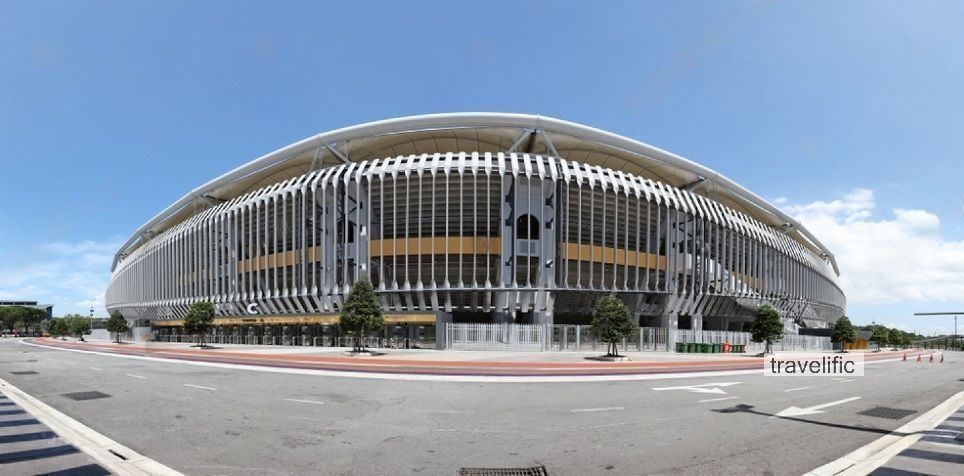
No visit to Beijing is complete without setting foot on the Beijing National Stadium or more popularly called the Bird´s Nest.

Standing opposite the Bird Nest is the National Aquatics Centre or Water Cube, a rectangular scaly blue structure which is temporarily closed.

The Bird´s Nest, the largest steel structure in the world has played host to the Olympics and the 2008 Summer Paralympics.

It served as the grounds for athletic events and the football final of the Beijing Olympics.

The Bird´s Nest still echoed the proud moment of the Chinese people with the opening ceremony of the Olympic Games by President Hu Jintao being replayed on a large screen during visiting hours.

There is also a gallery featuring many life-size Madame Tussaud wax images of the various Olympic International Committee Presidents. There is also a large souvenir shop where you can buy all things related to the Olympics.

3. Visit China Nationalities Museum

Location: West of the Olympic Green.

Website: www.emuseum.org.cn.

Entrance fee: RM30 (North Garden) and RM45 (both North and South Gardens)

It is lesser known than the other attractions but the China Nationalities Museum is really worth a visit because it is a lively place with ethnic songs and dances being performed everyday for tourists.

The museum that won the Prize for Protecting Ethnic Buildings at the Organisation Committee of World Conference of Architects in 1998 features 44 ethnic villages and 200 ethnic buildings.

It is huge and you need to set aside a few days to complete the museum! Each of the 56 nationalities here is represented through their unique abodes, places of worship as well as the interesting household utensils and gadgets that they use.

Also displayed are some boats painted bright red. The Dong ethnic group builds better-looking pagodas and bridges than the Han Chinese and these can be seen at the museum.

The more familiar ethnic groups found here are the Korean, Miao, Mongolian and Tibetan while the lesser-known includes the Bonan (sounds like our Punans), Dai (who are actually Thai), Salar, Wa and Daur.

Walking through the park feels like home to me because a lot of the houses and people share similar characteristics with Malaysians and Indonesians.

One group even has totem poles crafted with figures of their gods like those in Sarawak.

I also meet a Wah girl who resembles a Malay. The Wah, like the Minangkabaus, hang buffalo skulls at the fore of their houses.

The museum´s website describes the premise as a base to preserve the cultural heritage of the different ethnic groups and a place where people can exchange ideas and learn about each other.

4. Discover Zhongshan Garden

Location: Adjacent to the Palace Museum.

Entrance fee: RM1.50

Though most tourists may not visit this unassuming park, I did because of my curiosity with Dr Sun Yat Sen, the father of modern China. His hearse was temporarily placed at the Zhongshan hall here after his death.

Chinese emperors also came here to pray at the altar of the Gods of Land and Grain for good harvest. You would be greeted by Sun´s large statue at the entrance.

There are a few other things worth watching out for here. One is the Green Lotus rock, brought from southern China to Yuan Ming Yuan by Emperor Qiang Long because he was fascinated by its shape.

It carried his inscriptions in Chinese Green Lotus. There is also a strange intertwining Cypress and Locust trees that seem to have grown out of each other.

5. Visit Yonghegong Lama Temple

Location: No. 12, Yonghegong St, Dongcheng District Beijing.

Entrance fee: RM12.50

The largest Tibetan Buddhist temple in Beijing was built in the style of the Han, Man, Meng and Zang Chinese architecture. It was originally the mansion of Emperor Yongzheng. Many of the temple structures here have ornate sweeping multi-coloured arched roofs.

The most interesting sections of the old temples are the exotic and sacred statues of Tibetan Buddhism. They were sent as gifts from Tibet to the Manchu emperors.

Among the great treasures here are the congregation of 500 Luohan statues made of red sandalwood and the Maitreiya Buddha, of white sandalwood.

6. Walk in Beihai Park

Location: No. 1, Wenjin St. Xicheng District, Beijing.

Website: beihaipark.com.cn.

Entrance fee (April to Oct): RM5

While the Palace Museum enables you to experience the grandeur of imperial China, the Beihai Park enables you to savour the best royal gardens in China dating back 1,000 years.

You will see how northern Chinese gardens exude grandeur while the southern ones charms with grace and refinement especially with the use of plants and trees. Beihai also features a lake, palace buildings and temples, among others.

7. Taste Beijing roast duck

Location: Quanjude Building No.4, Qianmen West St, Xuanwu District, Beijing.

Website: www.quanjude.com.cn

Quanjude has been serving Beijing roast duck for more than 140 years. This is reputed to be Premier Zhou Enlai´s favourite roast duck joint because he actually instructed the restaurant to be built here.

The size of the restaurant is huge with 40 banqueting halls and can fit more than 2,000 guests. The golden hall on the fourth floor is worth taking a look as it is constructed with strong national characteristics exuding gracefulness.

8. Visit Temple of Heaven

Location: Tiantan Road, Chongwen District.

Website: www.tiantanpark.com.

Entrance fee: RM17.50

This is the largest temple structure in China for worshipping the heaven. The three-storey building looms towards the sky with three sweeping roofs. Topping the structure is a roof that is almost conical in shape. It is a favourite place for tourists to take pictures. Emperors of the Ming and Ching Dynasties came here annually to offer prayers to the Heaven for good harvest in the old days.

9. Take a ride on the Beijing Subway

Cost per ride: only RM1

You can go to most tourist spots in Beijing using the subway system. With every ride costing only RM1, it´s very cheap and easy to travel around. It´s of course easier to get around if you know Mandarin.

The subway workers are very obliging so it is easy to get help. One drawback is that they electronically screen your bags for dangerous objects before you enter the train.

The Beijing Subway was opened in 1971 and now service some four million rides a day. The network now has 147 stations and nine lines totalling 228km of tracks.

10. Explore the Forbidden City or the Palace Museum

Entrance fee: RM20

A visit to the Forbidden City enables you to see not only the largest palace monument but also the famous Tiananmen Square as you have to pass through its gate to enter the Forbidden City.

Of course, you won´t miss the picture of Mao Tse Tung, the founder of Republic of Communist China placed over the entrance gate.

The Forbidden City is anything but formidable. I have yet to go through the entire area even though I have been here twice, often getting lost in the pathways leading to where the emperors´ concubines used to live.

The main palace buildings through the centre of the park here are divided into the outer and inner courts.

The outer courts, known as the Taihe, Zhonghe and Baohe, were where the emperors worked and met with officials during rituals and ceremonies.

The inner courts - Qianging, Jiaotai and Kunning - were where the emperors lived and handled day to day work.

One interesting view was the royal wedding beds.

The palace monument ends with the royal garden at the rear, a place where the royal family enjoyed nature but also where concubines were picked.

The garden is filled with cypresses, pines, pavilions, rock art and plum trees. I was lucky when I was there as the plum trees were in full bloom.

The left and right wings of the court buildings have been turned into exhibition centres where royal art and craft are exhibited.

They include rare paintings, calligraphy, canopies, musical instruments, weapons, jade as well as large art objects in gold.

Source : New Straits Times – 8 April 2010


Post a Comment for Top 10 things to do in Beijing
Name* :
Email* :
Comment* :
Math Question*   

Check your answer first before submit button is enabled


Comments[0]


Custom Search

Advertisers


Cheap Airfares on Wego Travel Search

Terms of Service |  Privacy Policy |  RSS |  Copyright © NSTP e-Media Sdn Bhd (411895-A) Best viewed in 1280x1024 resolution.